
2026-08-15 15:36:22
Custom curved glass is increasingly specified for architectural projects where conventional flat glass cannot meet the required geometry, visual continuity, or functional performance. From curved façades and entrance structures to interior partitions, skylights, balustrades, and specialized building elements, the successful use of curved glass depends on much more than achieving a particular shape. Glass thickness, curvature, dimensional tolerances, processing methods, coating requirements, and installation conditions all need to be considered during the engineering stage.
For architects, façade contractors, and glass buyers, understanding the manufacturing process is therefore important when developing a custom curved glass solution.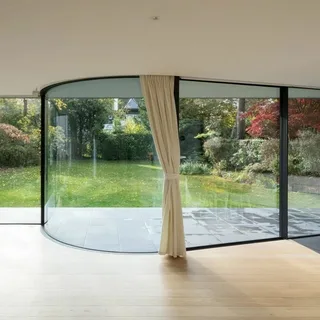
The manufacturing of custom curved glass begins with the project geometry. Important parameters include glass dimensions, thickness, bending radius, curvature direction, edge configuration, and required tolerances.
Unlike flat glass, curved glass has a three-dimensional geometry that can directly affect fabrication and installation. The specified radius needs to be compatible with the selected glass type and processing technology, while dimensional tolerances must be controlled to ensure proper alignment with the supporting structure.
For complex architectural projects, it is also important to consider the relationship between the glass geometry and the frame or façade system at the design stage. Accurate technical drawings and clear dimensional specifications can help reduce manufacturing adjustments and installation problems later in the project.
The basic manufacturing process involves heating the glass to an appropriate forming temperature and controlling its deformation to achieve the required curvature. The glass must be heated uniformly because uneven temperature distribution can affect the final shape, optical quality, and dimensional stability.
Depending on the required specification, curved glass may then undergo additional processes such as tempering, lamination, insulation, edge processing, or surface coating.
The bending process requires precise control of temperature, forming pressure, cooling conditions, and production parameters. For architectural applications where appearance is critical, manufacturers must also pay close attention to optical distortion and surface quality.
This is particularly important for large curved panels used in façades, where variations in curvature or optical quality can become more noticeable under changing daylight conditions.
The choice of glass substrate has a direct influence on the final performance of a custom curved glass panel.
Depending on the application, projects may require tempered glass for increased safety and mechanical strength, Laminated glass for enhanced safety and post-breakage retention, or insulated configurations for improved thermal performance.
For energy-efficient buildings, Low-E coatings and solar-control coatings may also be incorporated into the glass specification. However, coated glass requires appropriate processing and handling procedures during bending to maintain the performance and integrity of the coating.
The final configuration should therefore be determined according to the building's structural, thermal, acoustic, safety, and aesthetic requirements rather than selecting the glass type based only on appearance.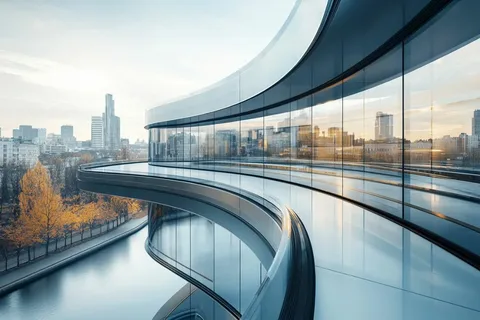
Quality control becomes especially important when producing customized curved glass because several variables must be controlled simultaneously.
Dimensional inspection verifies the overall size and geometry of the panel, while curvature inspection confirms that the finished glass corresponds to the specified bending radius. Edge quality, surface condition, coating integrity, and optical appearance should also be evaluated according to the project requirements.
For large architectural panels, consistent production is particularly important because small deviations can affect the fit between adjacent panels or create visible inconsistencies across a façade.
A reliable manufacturing process therefore combines accurate equipment, controlled forming parameters, experienced technicians, and systematic inspection procedures.
The flexibility of curved glass allows it to be applied to a variety of architectural structures.
In building façades, curved panels can follow complex exterior geometries and create continuous architectural surfaces. In entrances and canopies, curved glass can provide weather protection while maintaining transparency and natural light.
Inside buildings, curved glass can be used for partitions, balustrades, elevator areas, decorative walls, and other architectural features. Depending on the project, the glass can also be combined with different coatings, laminations, or insulated configurations to achieve specific performance requirements.
Another specialized solution is Reverse Curved Glass, which can be manufactured according to a defined curvature and project geometry. This type of glass is particularly relevant when the architectural design requires a specific curved profile rather than a conventional flat panel.
Custom curved glass should ideally be considered together with the building's overall design and installation system. The glass manufacturer, architect, façade contractor, and engineering team may need to coordinate dimensions, connection details, tolerances, glass configuration, and installation methods before production begins.
Early technical coordination can help identify potential conflicts between the glass geometry and supporting structure. It can also reduce the risk of costly modifications after fabrication.
For international architectural projects, manufacturers should also be able to communicate technical specifications clearly and provide appropriate processing options according to the project's requirements.
Choosing a suitable manufacturer is an important part of any curved glass project. Buyers should evaluate not only the manufacturer's ability to produce a particular curved shape, but also its capabilities in glass processing, tempering, lamination, coating, dimensional inspection, and quality control.
A manufacturer with experience in customized architectural glass can help evaluate whether the proposed dimensions and curvature are technically suitable before production begins. This engineering input can be especially valuable for large or complex curved panels.
For projects requiring a customized solution, YT Glass Group provides architectural glass processing capabilities covering curved glass and other specialized glass configurations. Buyers can review the specifications and applications of Reverse Curved Glass to understand how a customized curved glass solution can be developed for a specific architectural project.
The production of custom curved glass is a combination of architectural design, material selection, controlled glass bending, precision processing, and quality inspection. Achieving the desired curvature is only one part of the process; maintaining dimensional accuracy, optical quality, safety performance, and compatibility with the installation system is equally important.
For architects, façade contractors, and project buyers, defining the glass geometry and performance requirements at an early stage can make the manufacturing process more predictable and help ensure that the finished curved glass meets the requirements of the final application.

Building 1, No. 82 Chaodong Road, Chashan Town, Dongguan City, Guangdong Province
+86 13725796789
Copyright © 2026 Dongguan Yinjian Glass Engineering Co., Ltd All Rights Reserved